Skip to content
The ASP(Activated Sludge Process) Sewage Treatment Plant aimed to modernize its wastewater treatment operations by implementing a centralized smart monitoring and automation platform. The objective was to improve process visibility, optimize aeration and sludge management operations, enhance treated water quality, reduce energy consumption, and ensure consistent compliance with environmental standards.
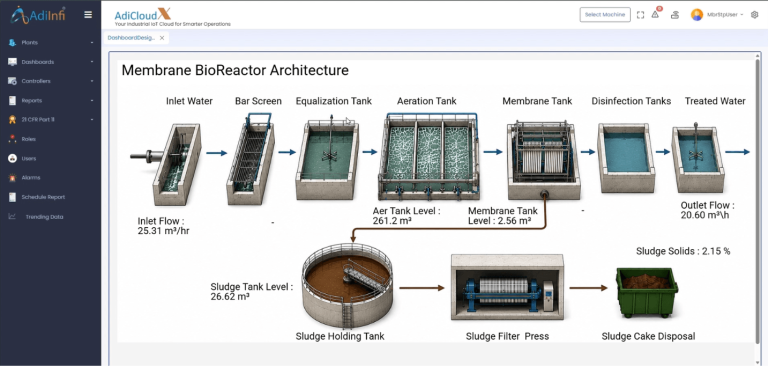
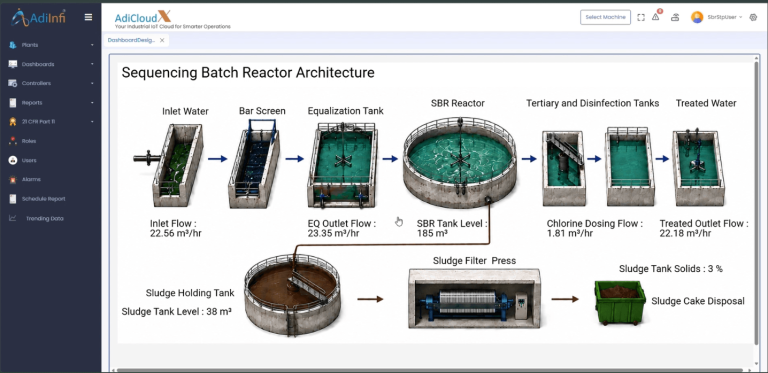
By integrating the IoT-based cloud platform AdiCloudX with theAdiNexus Industrial IoT Gateway, the entire STP was transformed into a digitally connected and intelligent treatment facility. The solution enabled real-time monitoring of influent and treated water flow, aeration tank performance, sludge recirculation systems, clarifier levels, blowers, pumps, dissolved oxygen (DO), pH, MLSS concentration, filtration systems, and other critical process parameters through a centralized dashboard accessible from anywhere.
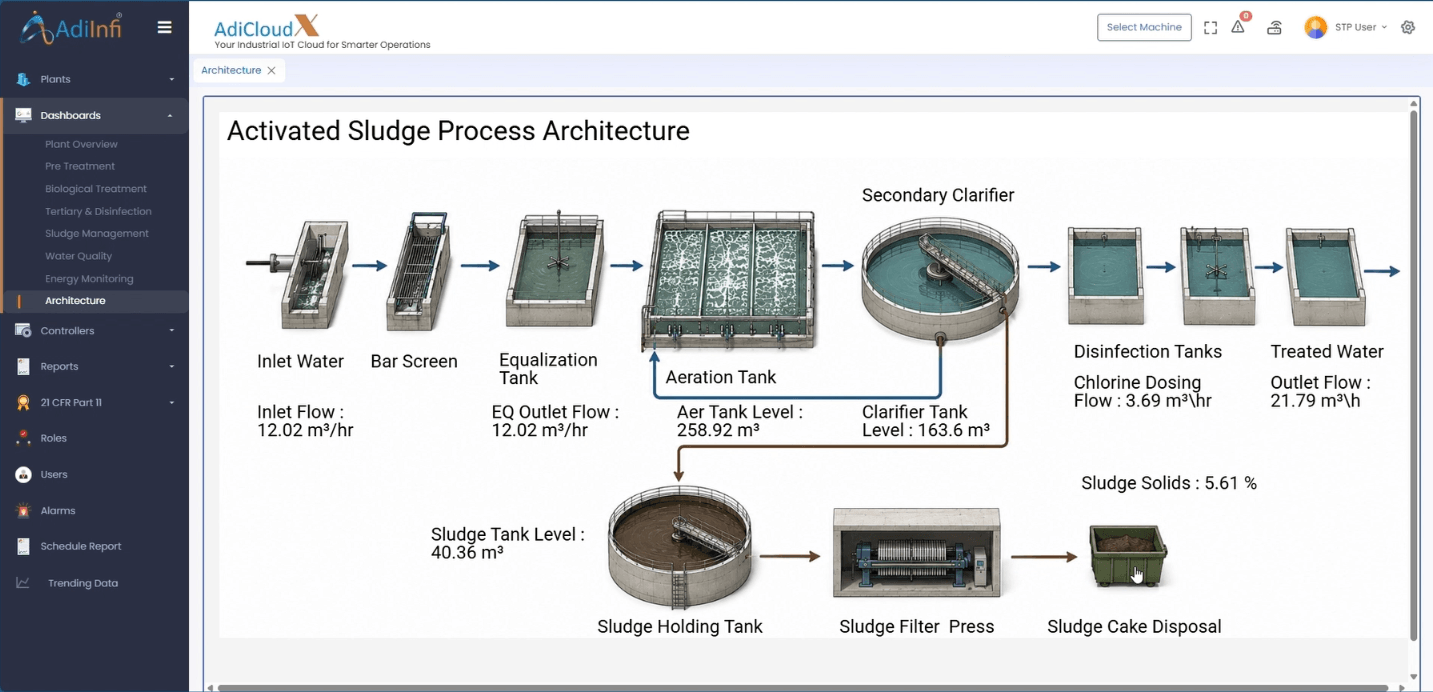
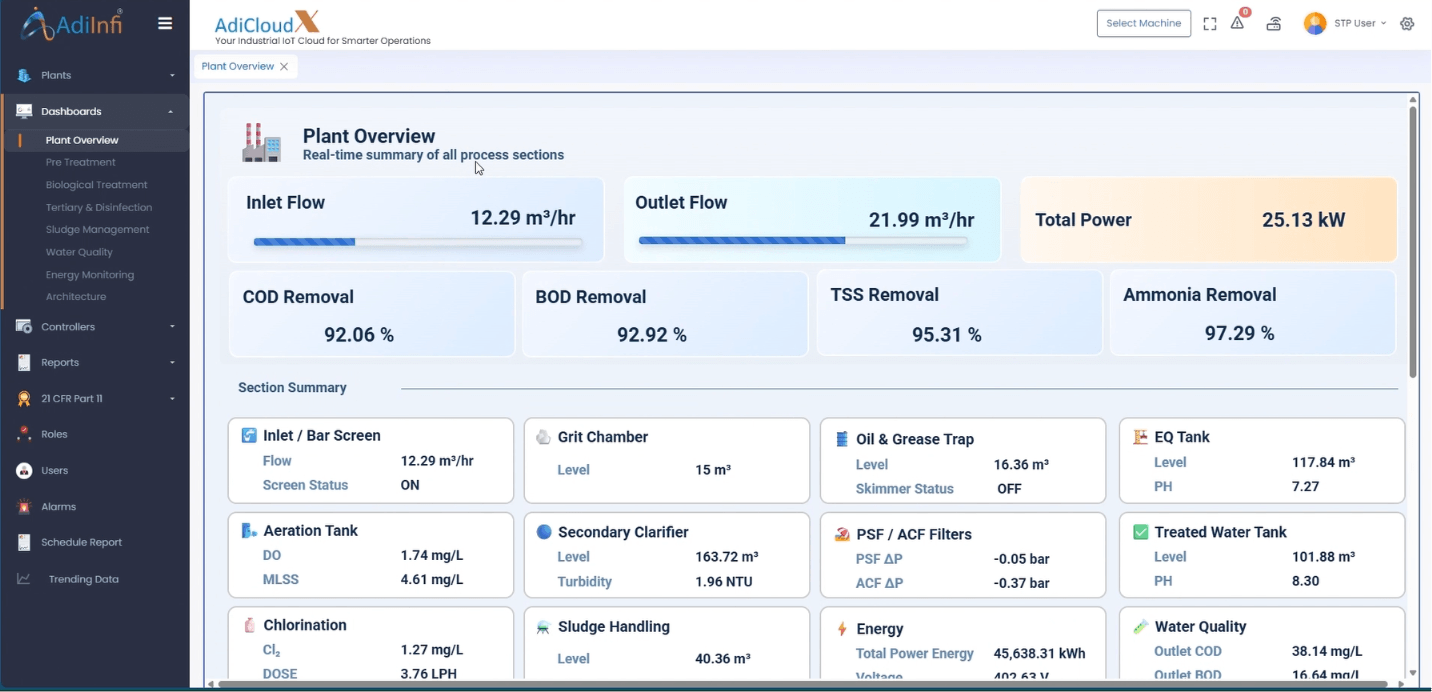
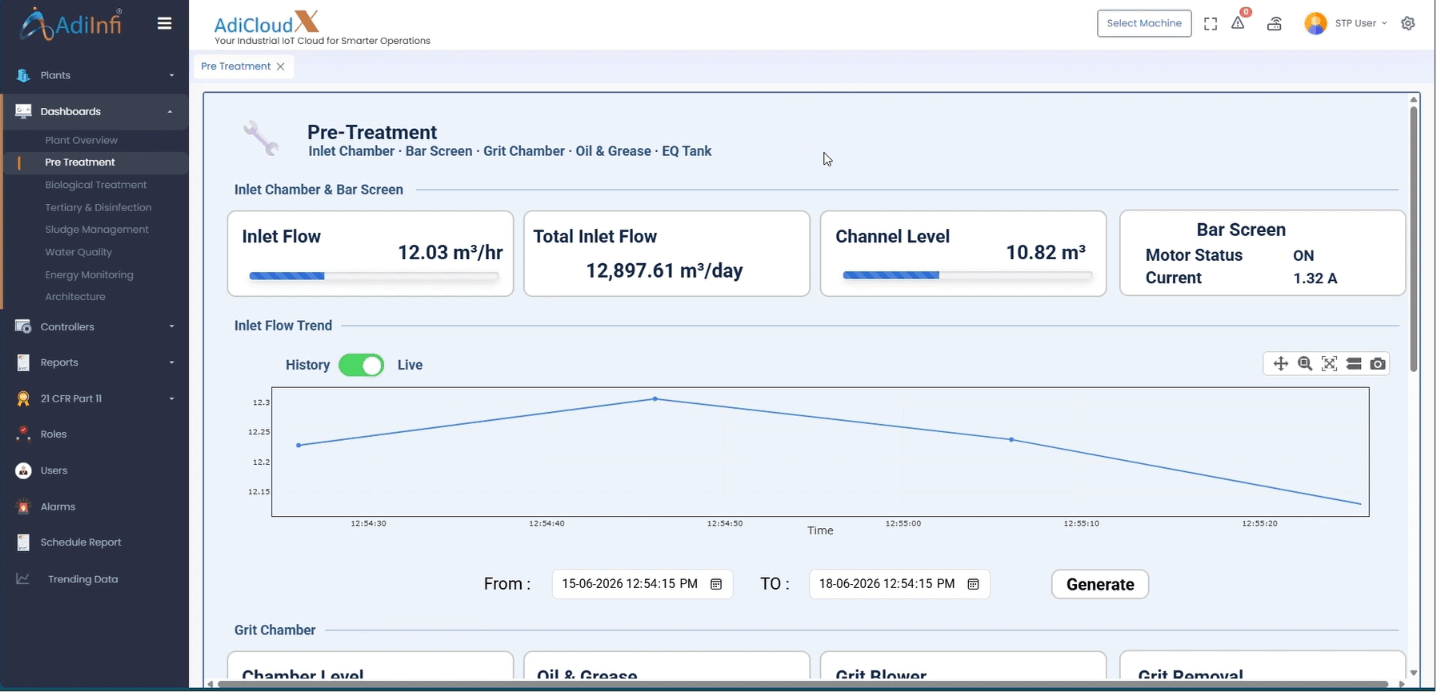
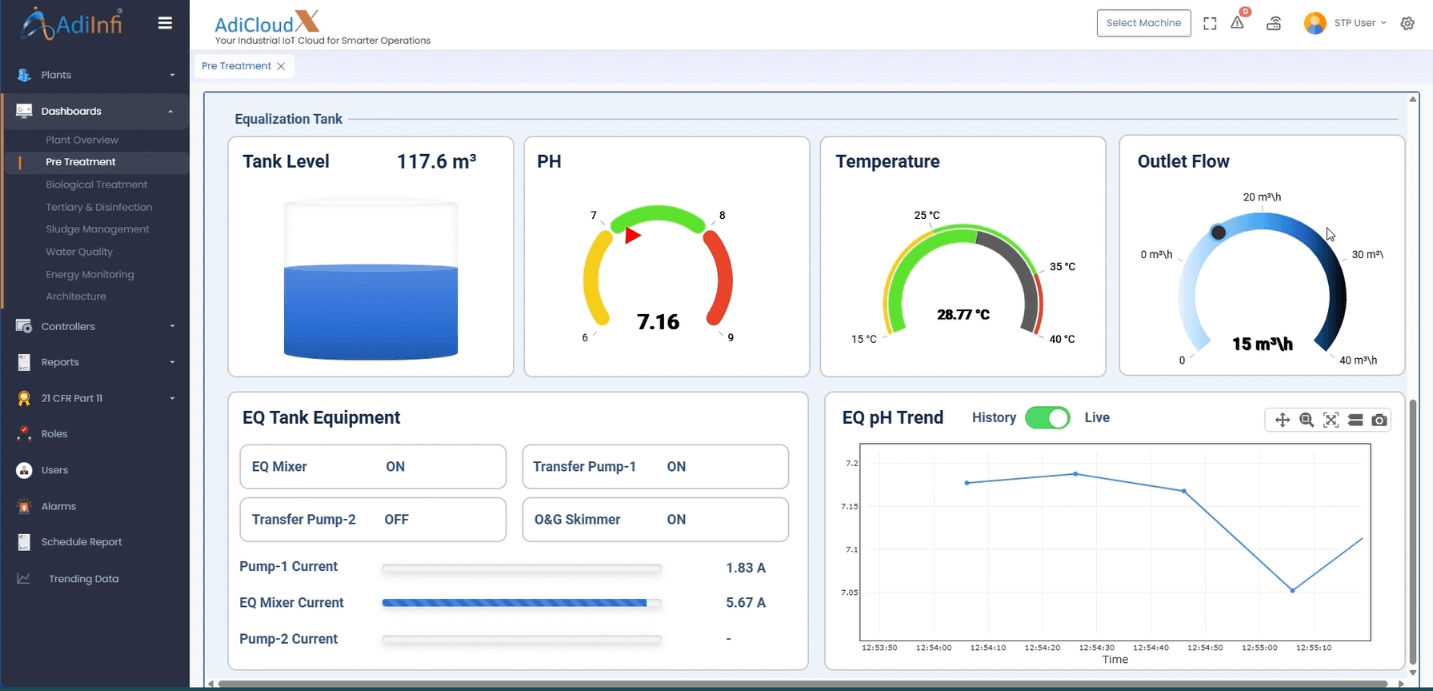
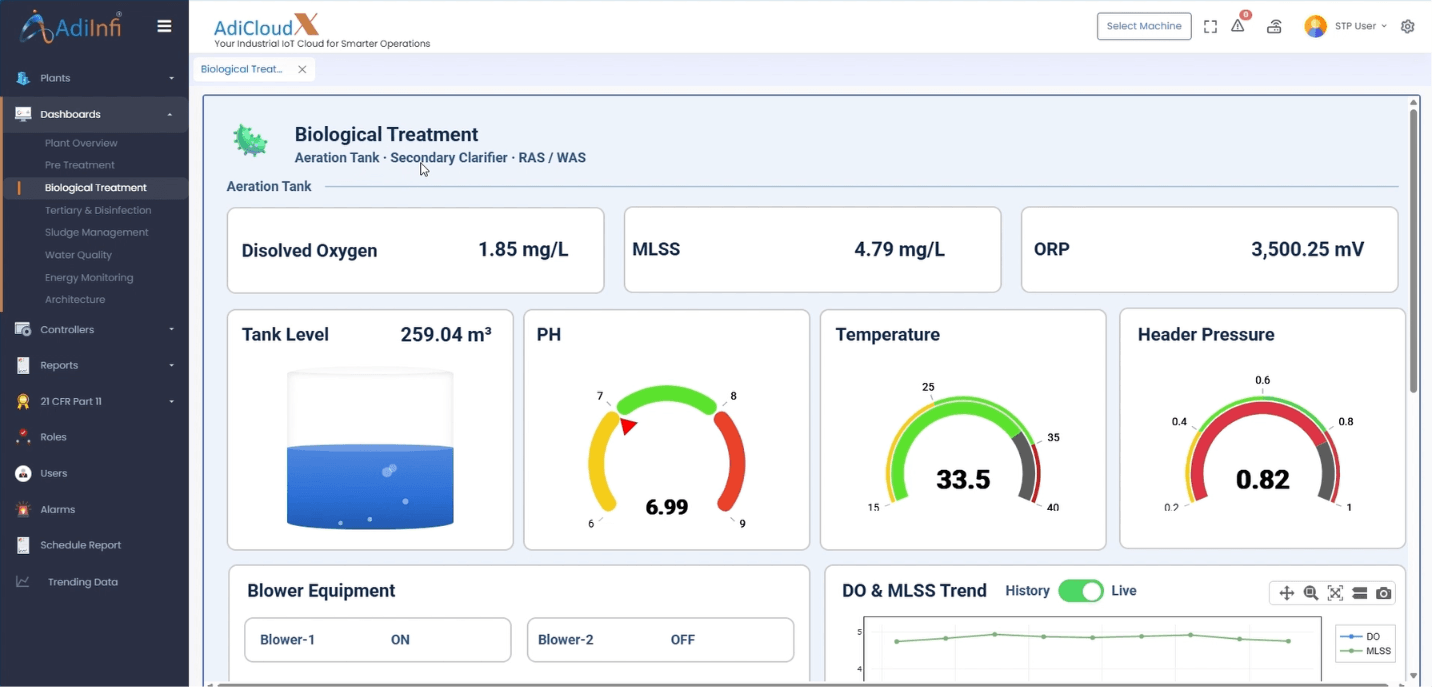
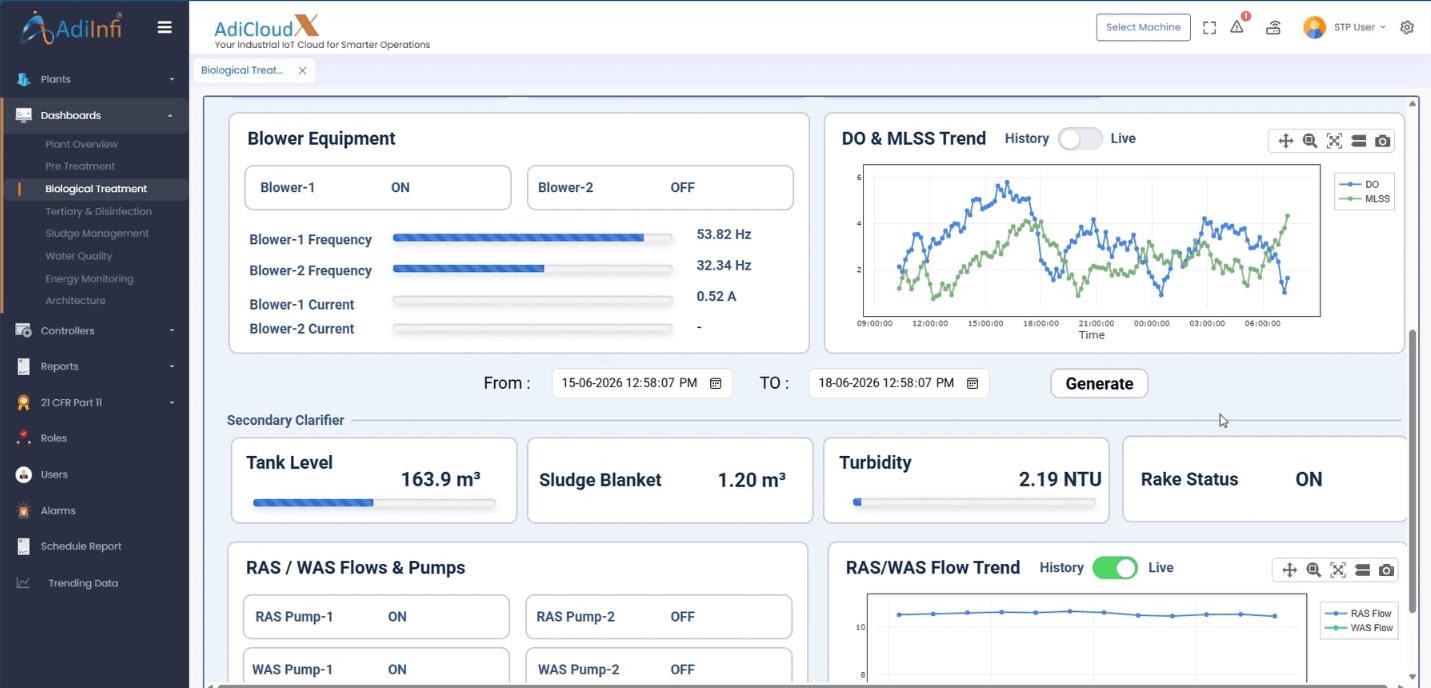
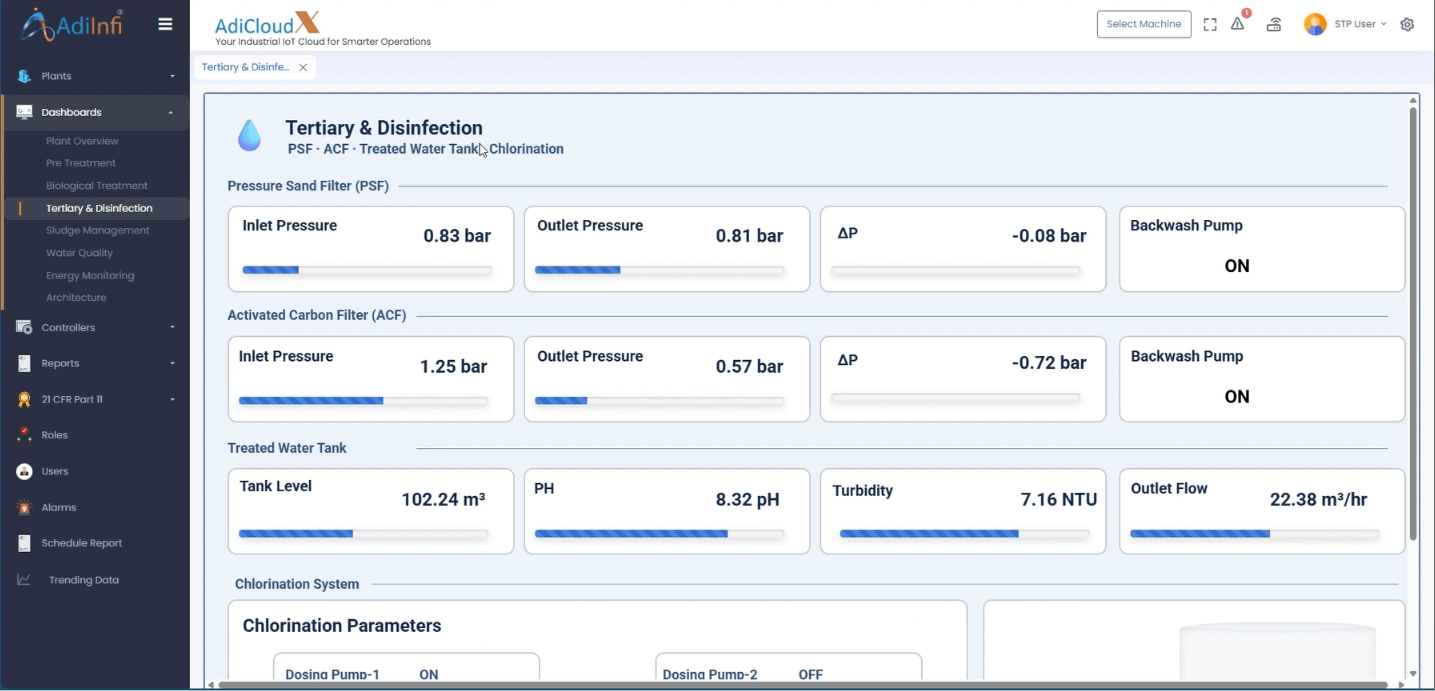
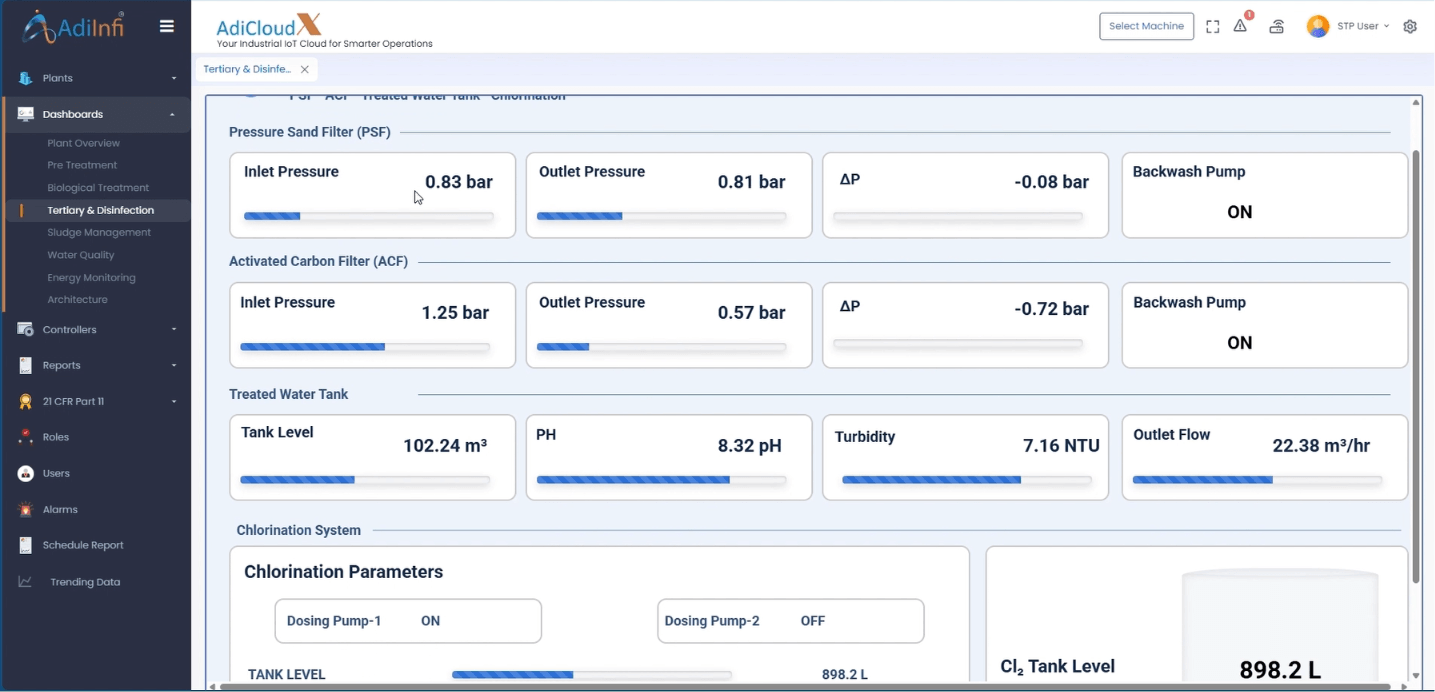
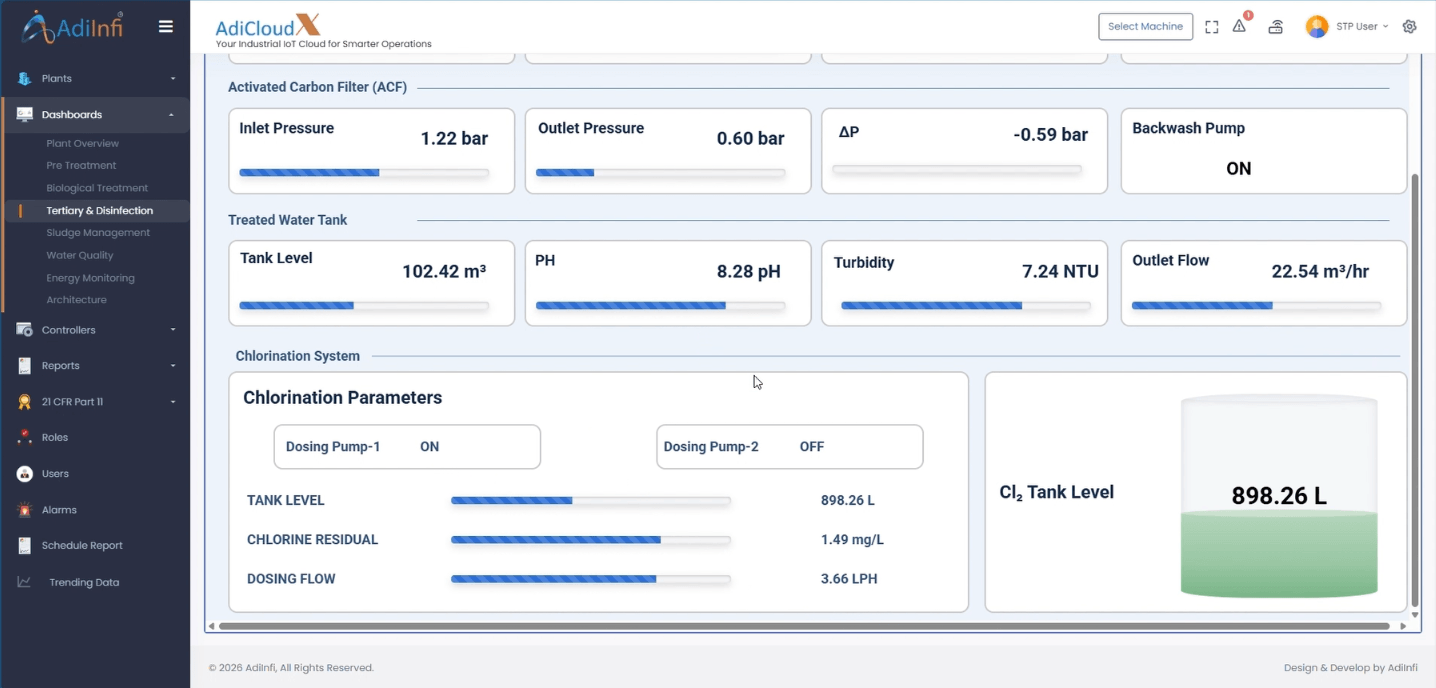
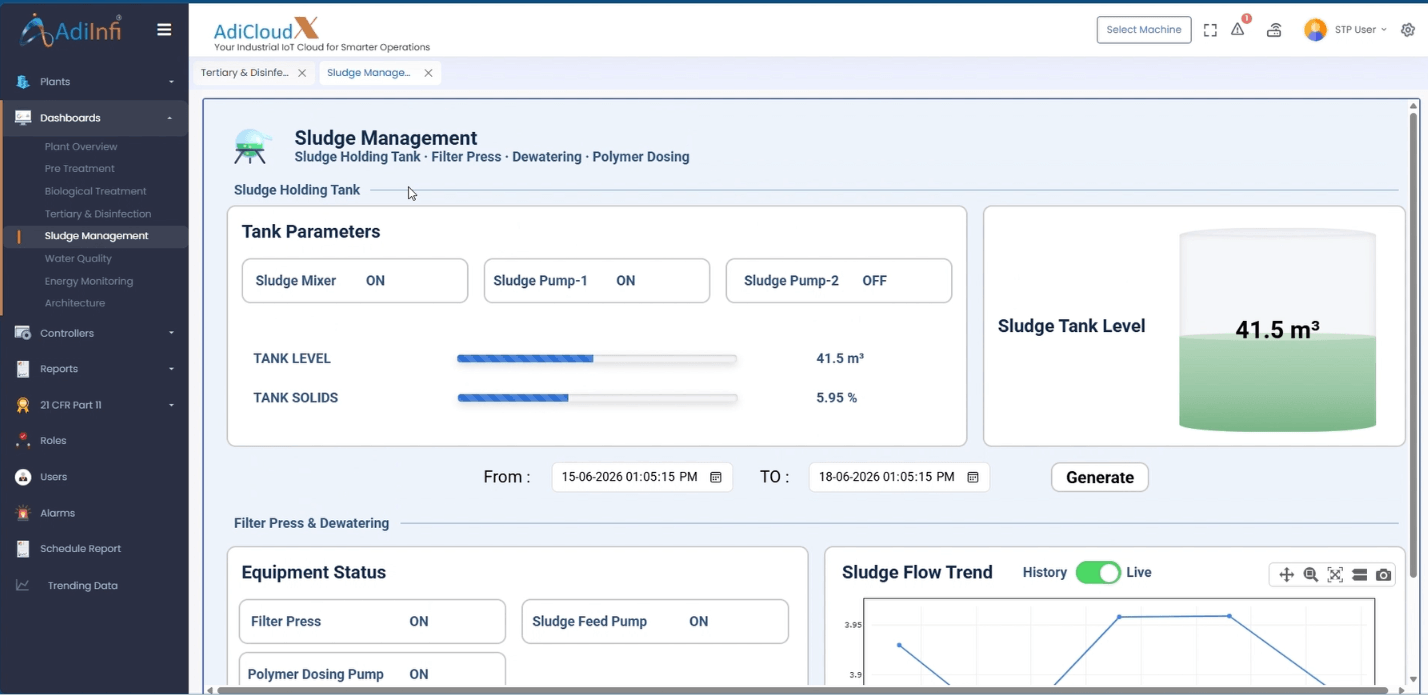
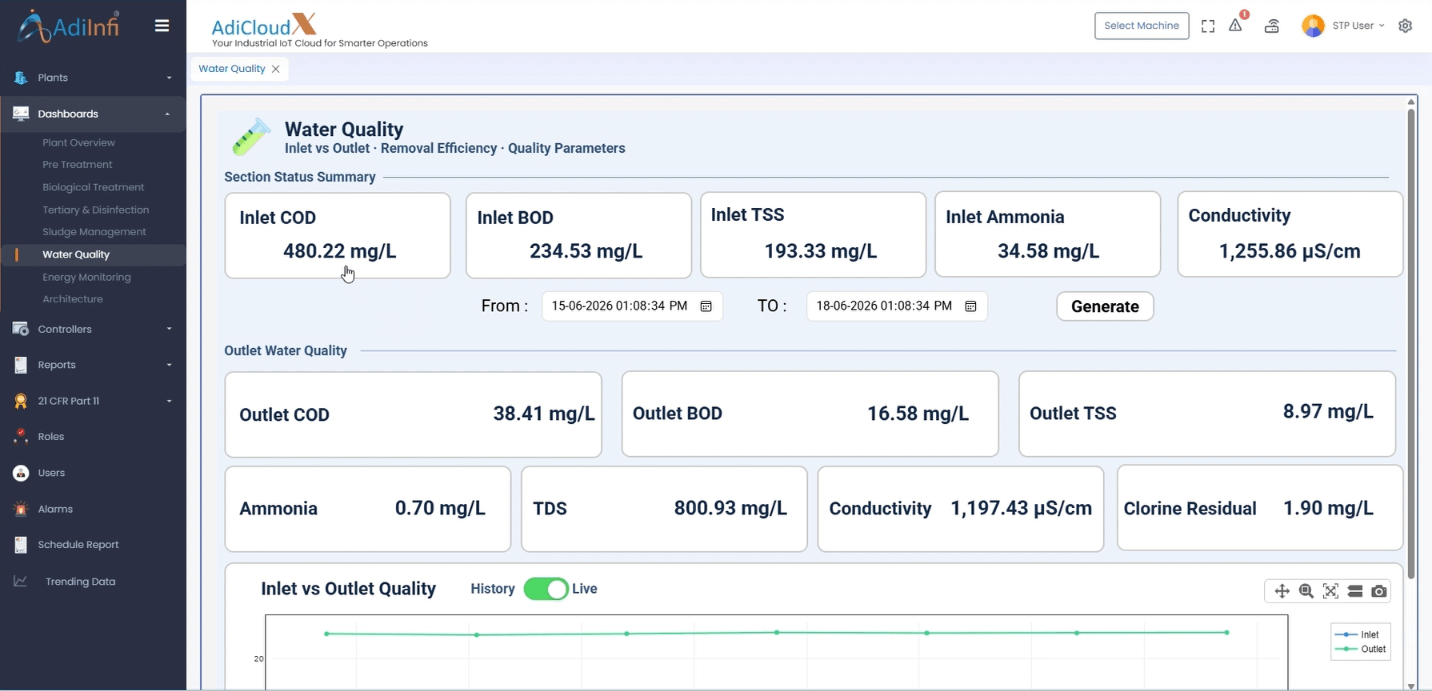
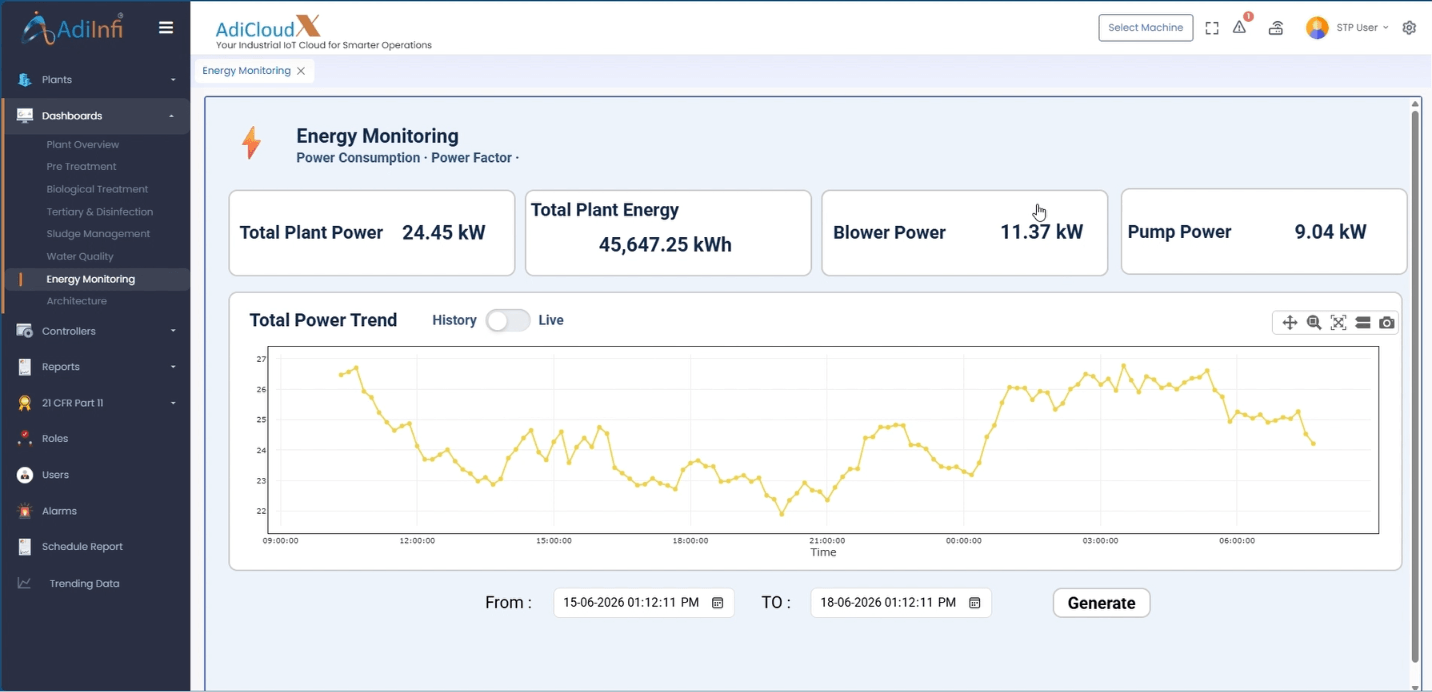
ASP STP Plant Overview
The implementation focused on building a scalable, secure, and intelligent SCADA infrastructure for monitoring and controlling critical wastewater treatment processes throughout the ASP (Activated Sludge Process) Sewage Treatment Plant.
Inlet & Equalization System
- Receives and balances incoming sewage flow before biological treatment
- Monitors inlet flow rates, tank levels, and transfer pump operations
- Prevents hydraulic fluctuations that can impact treatment efficiency
- Supports automated pump control and overflow management
Aeration Tank
- Core biological treatment process where microorganisms degrade organic pollutants
- Monitors dissolved oxygen (DO), blower status, airflow, MLSS levels, and tank conditions
- Optimizes aeration efficiency for effective biological treatment
- Supports automatic blower control based on oxygen demand and process load
Secondary Clarifier
- Separates treated wastewater from activated sludge
- Monitors sludge blanket levels, scraper mechanisms, and overflow conditions
- Ensures efficient settling and solids removal
- Provides alerts for abnormal sludge accumulation and clarifier performance issues
Filtration & Treated Water System
- Includes pressure sand filters, activated carbon filters, and treated water storage facilities
- Monitors filtration pressure, backwash cycles, and treated water flow
- Ensures treated water meets discharge and reuse quality standards
- Supports automated filter operation and maintenance scheduling
Water Quality Monitoring System
- Continuously monitors critical treatment parameters such as pH, Dissolved Oxygen (DO), Turbidity, MLSS, and Flow
- Provides real-time visibility into treatment efficiency and plant performance
- Generates alerts when water quality parameters exceed permissible limits
- Supports regulatory compliance and treated water quality assurance
- Enables historical analysis, reporting, and process optimization
Utility & Equipment Monitoring
- Continuously monitors pumps, blowers, motors, compressors, and electrical systems
- Tracks runtime, current, voltage, energy consumption, and fault conditions
- Enables predictive maintenance and equipment health analysis
- Reduces unexpected downtime and operational disruptions
- Improves overall operational reliability and energy efficiency of the ASP STP facility
Challenges Before AdiCloudX Implementation
Before adopting AdiCloudX, the ASP STP faced multiple operational and process management challenges.
Manual Monitoring & Reporting
Most treatment parameters were monitored manually, leading to:
- Delayed reporting and decision-making
- Human errors in data recording
- Limited process visibility
- Lack of reliable historical records
Limited Visibility into Treatment Performance
Operators had difficulty tracking:
- Dissolved oxygen levels in aeration tanks
- MLSS concentration and biological process health
- RAS and WAS system performance
- Blower and pump operations
- Clarifier efficiency and sludge settling performance
- Equipment health and operational trends
High Energy Consumption
Without intelligent control systems:
- Aeration blowers frequently operated continuously
- Excessive energy was consumed to maintain treatment processes
- Pumps operated inefficiently based on fixed schedules
- Operational costs increased unnecessarily
Delayed Detection of Equipment Faults
When equipment failures occurred, it was difficult to determine:
- Which asset had failed
- Duration of downtime
- Root cause of the issue
- Maintenance requirements
- Impact on treatment performance
This resulted in slower response times, increased operational risk, process instability, and prolonged equipment downtime.
No Centralized Real-Time Visibility
Plant operators and management lacked a unified dashboard to monitor:
- Influent and effluent flow rates
- Aeration tank conditions
- Dissolved oxygen (DO) levels
- MLSS concentration
- RAS and WAS pump status
- Clarifier performance
- Pump and blower health
- Treated water quality
- Energy consumption
Compliance & Reporting Challenges
Generating regulatory and operational reports required significant manual effort, making it difficult to:
- Track treatment performance
- Verify discharge compliance parameters
- Analyze historical trends
- Demonstrate operational efficiency
- Maintain complete audit and reporting records
Solution – AdiCloudX Industrial IoT Platform
AdiCloudX was deployed to transform the ASP Sewage Treatment Plant into a smart, connected, and data-driven wastewater treatment facility.
The solution enabled centralized monitoring and intelligent control of treatment processes, including inlet pumping systems, equalization tanks, aeration tanks, activated sludge processes, RAS and WAS systems, blowers, secondary clarifiers, filtration units, treated water storage systems, and utility equipment through a secure cloud-based SCADA platform.
Industrial data from PLCs, sensors, analyzers, energy meters, and field devices is collected through the AdiNexus Industrial IoT Gateway and securely transmitted to the AdiCloudX cloud platform, where it is processed, analyzed, and visualized through advanced operational dashboards.
Real-time monitoring of critical parameters such as dissolved oxygen (DO), pH, MLSS concentration, flow rates, sludge recirculation performance, tank levels, blower efficiency, pump health, and treated water quality enables operators to make informed decisions and optimize plant performance. Automated alerts, historical trend analysis, reporting tools, and remote accessibility provide complete visibility into plant operations while supporting regulatory compliance, energy optimization, predictive maintenance, and continuous process improvement.
The system enables:
- Real-time treatment process monitoring
- Aeration tank performance monitoring and optimization
- Tank level monitoring and control
- Dissolved Oxygen (DO), pH, and MLSS monitoring
- RAS and WAS system monitoring
- Pump and blower performance analytics
- Clarifier performance monitoring
- Water quality monitoring
- Alarm and event management
- Equipment fault and downtime tracking
- Historical trend analysis
- Energy consumption monitoring
- Predictive maintenance and equipment health analysis
- Operational intelligence and reporting
- Remote access and centralized plant visibility
- Regulatory compliance monitoring and automated reporting
Key Features Implemented
Water Quality Monitoring
Continuously monitors pH, Dissolved Oxygen (DO), MLSS, and Turbidity to ensure optimal treatment performance and regulatory compliance.
Pump & Blower Monitoring
Provides real-time monitoring of equipment status, runtime, energy consumption, and fault conditions to improve reliability and reduce downtime.
Automated Data Collection
Automatically collects data from PLCs, sensors, analyzers, and field instruments, eliminating manual errors and improving data accuracy.
Historical Data Storage
Securely stores operational data in the cloud for trend analysis, compliance reporting, and performance evaluation.
Tank Level Monitoring
Monitors inlet tanks, aeration tanks, and clarifier levels in real time to prevent overflows, dry-run conditions, and process disruptions.
Alarm & Event Notifications
Generates instant alerts for equipment faults, abnormal levels, and process deviations, enabling faster response and corrective action.
Why Choose AdiCloudX SCADA
AdiCloudX is a powerful Industrial IoT Cloud SCADA platform developed by AdiInfi, designed for wastewater treatment plants, industrial automation systems, utilities, and smart infrastructure applications.
The platform enables organizations to digitally transform traditional treatment facilities into intelligent, connected, and data-driven operational ecosystems with improved efficiency, visibility, and control.
It enables facilities to
- Connect PLCs, RTUs, Sensors & Industrial Devices
- Real-Time Treatment Process Monitoring
- Advanced Analytics & Operational Intelligence
- Reduce Equipment Downtime & Maintenance Costs
- Optimize Energy Consumption
- Centralized Cloud SCADA Platform
- Historical Data Logging & Reporting
- Secure Industrial Communication
- Remote Monitoring & Mobile Accessibility
Scalability & Deployment
The platform is designed for high scalability and multi-site operations, allowing organizations to:
- Monitor multiple treatment units from a single dashboard
- Manage multiple STP/ETP plants across different locations
- Integrate geographically distributed industrial facilities
- Standardize operations across all sites with unified control logic
Conclusion
With real-time dashboards, process analytics, automated monitoring, and centralized reporting, plant operators gained complete visibility into treatment processes, equipment performance, water quality parameters, and energy consumption across the facility.
The deployment significantly improved treatment efficiency, reduced equipment downtime, optimized energy usage, minimized manual operations, and enabled faster decision-making through real-time operational intelligence.
This case study demonstrates how Industrial IoT and cloud SCADA platforms like AdiCloudX can modernize wastewater treatment operations by enabling intelligent monitoring, predictive maintenance, process optimization, and data-driven plant management.
Using AdiCloudX and the AdiNexus Industrial IoT Gateway, organizations can build scalable, reliable, and future-ready sewage treatment systems that improve operational performance, ensure regulatory compliance, and reduce overall operating costs.